Tuesday, April 3, 2012

Cumin Harvest

Over the last few months, we've been growing a new crop at the garden: cumin. I have always liked this spice so I decided that it was about time to try and grow it.

We planted the seeds last February in the back quarter of one of our beds. They were a little slow to get started.
I was confused initially because the young plants look and smell like dill. I was worried that I got my seeds mixed up.

Fortunately, after the first month, the cumin patch really took off. Slowly the feathery branches began to form into a dense canopy.
They also started producing many clusters of pink flowers that were a huge relief because they smelled like cumin. From there, the cumin patch just kept producing more and more flowers.
The picture above was taken about a month before harvest. In it, you can see that some of the stems were starting to yellow and many of the flowers were now seeds. At this point, I found that you could harvest green cumin seeds to use fresh and they are delicious.

One issue we had was that these cumin plants had a pretty substantial aphid population. The did not look like they were hurting the plants, but I did not want to have aphids in the garden's cumin container.

I was also worried that the early maturing seeds would fall off the plant too soon, but that certainly did not happen. In fact, I ran into the opposite problem. Threshing was pretty difficult.

When the cumin plants were almost entirely yellow and dry, I decided to pull them and let them hang to continue to dry out (also, the aphids made themselves scarce during this stage). After two days, I put them in a bag and beat the bag against our fence to try and knock the seeds off. This had next to no effect. Therefore, I had to go with the slower method of knocking the seeds off by hand. (Note: I found that the best method was rolling a bundle of cumin plants between your hands as if you were shaping a cylinder of dough.)
The result was pretty stemmy. Therefore, as you can see, I tossed it into a big colander and shook the seeds through.
This worked well, but I then had a lot of small leaves and chaff in with my cumin seeds. I then walked outside on a nice windy day and tried my hand at winnowing seed. This involves dropping the seed from about a foot or two above your container. The lighter leaves and sticks get blown away by the wind, and the more dense seeds drop safely back into your container.

Or at least that is how it is supposed to work. I lost a lot of my undersized cumin seeds this way and this was probably my most wasteful step. However, I happily ended with over 2 cups of cumin seed. I definitely grew more, but lost a lot while threshing and winnowing.

Wednesday, March 28, 2012

Chicken Psychology

Now that we are collecting 4-5 eggs per day from our chicken coop, it's a good time to reflect on the busy alchemists who transform our otherwise wasted food into a high-quality local protein source. Normally, our hens lead simple looking lives, pecking food, walking around their pen, and falling asleep in piles.
However, every so often the chickens will do something unexpected. An example of this is their regular and oxymoronic dust baths. On a nice dry day, our chickens casually walk out to a dusty patch of the pen, pause for a moment, then drop onto their stomach and do a surprisingly accurate impersonation of a pig wallowing. The ladies then spend a couple minutes thoroughly covering themselves with dust. They are trying to work fine dust into their feathers so that the dust can irritate pests like fleas that are living in their feathers. This ritual is interesting because it does not make logical sense and could not be learned from their parents because the chickens were most likely separated from their parents at the egg stage. This leaves us with a bit of a mystery. How did the chickens learn to dust bathe?

To figure out their odd habits and strange decision making, we are going to have to delve into that grape-sized black box: the chicken brain.
Thanks to all the feathers and being raised around foghorn leghorn, I think chickens look pretty friendly most of the time, but every so often, a chicken will give you a look that reminds you that they aren't quite wired the same way most animals are. This is because chickens are more closely related to reptiles than mammals.


Because they are closer to reptiles, their brains are also much more like a reptilian brain. The one major difference between a mammal's brain and a reptile's brain is the relative size of the cerebrum. The cerebrum is what is traditionally considered "the brain." All your major thoughts, feelings, and memories occur in the cerebrum. Keep in mind that this is the active part of the brain and involves learning.

As some of you might be surprised to learn, there is another very important section in brains: the spinal column. As you might guess, this area of the brain is where the spine attaches to the skull. This area is the home to a variety of pre-programmed functions. The spinal column is the reason you aren't currently having remember to pump blood with your heart or remember to move digested food from your stomach to lower intestine. The spinal column, unlike the cerebrum, involves no active learning or conscious thought.

In chickens and reptiles, the spinal column is much larger relative to the cerebrum. This means that chickens are born with most of the skills they need to survive already embedded in their spinal column and rarely use their cerebrum. In fact, the cerebrum is so unimportant to chickens that a farmer once cut the head off a chicken, removing the cerebrum but not the spinal column. This left the chicken with enough brain function to live for 18 months.

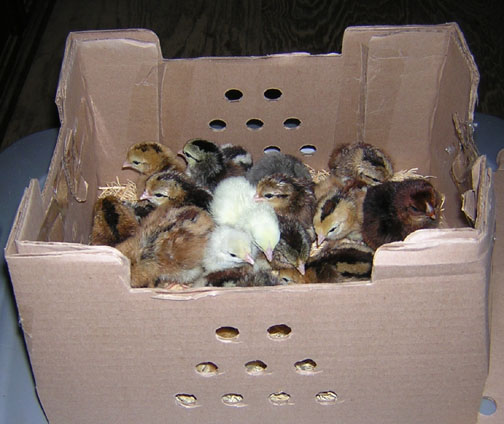
Having chicken young pre-programmed is a pretty neat trick for the chickens and is also helpful for chicken owners. Since chickens come with their own built in operating instructions (rather than learning from parents), society can get away with shipping chicks around the country. This shipping greatly simplifies starting a chicken farm and also results in the best Fedex drop-off you will ever receive. Nothing says "good morning" like being handed a hot, shaking, and peeping shipping box.


Despite no older generation to imitate, all of these chicks will grow up and know how to build nests, hunt insects, and mate. This also explains our dust bathing mystery from before.

The fact that chickens are born with pre-set programming does come with a down side. Chickens are not as quick to learn and have a hard time dealing with new situations. For example, the chicken who lived after having it's cerebrum removed continued to attempt to peck food and clean itself despite lacking a beak (or a face, for that matter).

I noticed this lack of learning in one other situation: Chickens, like dogs, have strong group instincts because a lone chicken will quickly become fox-food. So if a chicken hasn't seen a flock member lately, the flock member is assumed to be dead. This makes Dave and my situation particularly entertaining. As their caretakers, we stock up their food every Saturday and then are assumed to be dead when we fail to arrive Sunday (because the garden is closed). Monday, however, brings our triumphant rebirth when we arrive to once again clean their coop and collect their eggs.
Speaking of eggs, I should probably go check on the chickens now. Even if their nest boxes are empty, the entertainment value of visiting the coop makes the trip worth it.